|
||||
|
Home 首頁 |
Services 服務 |
News 新訊 |
Support 支援 |
|


 AMPSA
INC.
AMPSA
INC.www.ampsa.com
|
AMPSA
INC. www.ampsa.com |
||||||||||
AMPLIFIER, OSCILLATOR AND IMPEDANCE MATCHING DESIGN TECHNOLOGY
MULTIMATCH V8.50 / MOSAIC V8.50 (Register now and download the Demonstration Version)
USE THE POWER OF PRACTICAL SYNTHESIS TO DESIGN BETTER PRODUCTS FASTER

 Features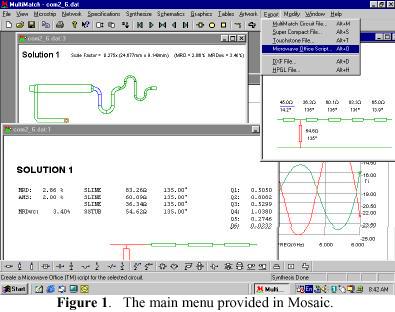
Ampsa provides you with the design technology to realize high quality RF and microwave amplifiers (class A, B) , at an affordable price, in its MultiMatch software. MultiMatch also has powerful oscillator synthesis capabilities. Because of its specialized structure and its powerful real-world synthesis, analysis, optimization and artwork tools, design cycles are reduced to a fraction of the time previously required. Circuits designed with MultiMatch are usually more robust (less sensitive) than those designed with other tools. This derives in part from the synthesis-based systematic searches implemented to ensure that the solution to each matching and modification problem is close to optimum (Forced solutions tend to be sensitive). MultiMatch extends the power of the expert designer and also provides a learning curve for inexperienced circuit designers.
MultiMatch is typically used as a front-end to one of the popular RF and microwave circuit simulators. The circuits synthesized/designed can be exported as Microwave Office? schematic scripts, or in Super Compact? or Touchstone? nodal analysis format. The artwork generated can also be exported in DXF or HPGL format.
Products
The Mosaic
Impedance-Matching Wizard (V8.50; MFC Windows 98/NT/2000/XPTM multiple
document
Visual C++ program):
Solves user-defined (equivalent) passive impedance-matching problems up to
artwork level. The source and/or the load impedance may be complex, and the gain
slope can be controlled too.
The MultiMatch
Amplifier Design Wizard (V8.50; MFC Windows 98/NT/2000/XPTM multiple
document
Visual C++ program):
Amplifier synthesis and impedance-matching software. Small-signal, low-noise,
power and high dynamic range amplifiers can be synthesized.
The circuits synthesized can be analyzed and optimized too. Analysis includes
loop gain and reflection gain analysis. Optimization includes direct
optimization and optimization by re-synthesis. Load-pull contours and constant
gain | noise figure circles can also be generated for transistors biased in
class A or B mode.
MultiMatch V7.70
(Extended DOS 32-bit WatcomTM Fortran Program):
Synthesizes amplifiers, oscillators and impedancematching networks. Balanced and
push-pull amplifiers can be designed by combining the single-ended strip
synthesized in MultiMatch externally.
Data Required
Matching problems must be specified in “real-frequency” format (Impedance-matching data can also be imported from TouchstoneTM .s2p files). The equivalent passive matching problem associated with controlling the active performance of a transistor can also be set up automatically in MultiMatch V8.30 and V7.70. When an amplifier or an oscillator is synthesized, Sparameters must be specified for the transistor(s) of interest in Touchstone? .s2p format. A small-signal model, the IVcurve boundaries (four boundary lines) and the dc operating point must be specified in order to control the 1 dB compression point (output power) of the transistor (class A, B mode). The required small-signal models can be specified in MultiMatch V8.25, and can also be fitted in MultiMatch V7.70 and V8.30. The model is used to map the external voltage and current to the intrinsic quantities. Current clipping and voltage clipping are used to predict the maximum linear output power of a transistor.
Mosaic and Mosaic Senior Capabilities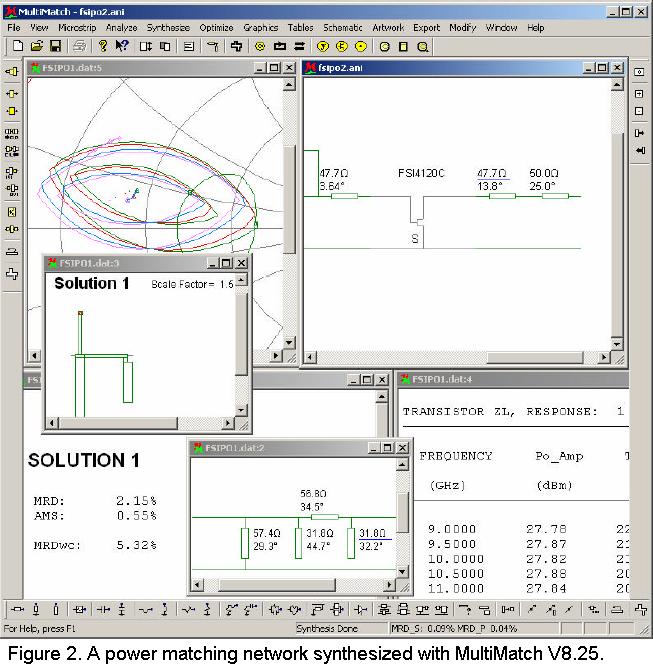
Mosaic synthesizes high quality RF and microwave impedance matching networks up to artwork (microstrip) level. The components and the microstrip lines used are assumed to be lossless during synthesis. Pads and connecting lines, as well as parasitic inductance for capacitors, can be specified for the networks to be synthesized. Shunt overlay capacitors and stepped main line sections may also be used. Connections to the ground plane can be made with vias or with bond wires. The impedance-matching problem to be solved can be specified directly (“real-frequency” format) or data can be imported from TouchstoneTM .s2p files. Different types of networks can be synthesized with Mosaic. These include:
Lumped-element networks,
Commensurate distributed/microstrip networks (line lengths specified, widths
used as variables),
Non-commensurate distributed/microstrip networks (line widths specified, lengths
used as variables) and
Mixed lumped/distributed networks.
Synthesis is generally over topologies (topology independent), but extensive control is provided over the synthesis parameters. Several solutions (usually with different topologies) are provided to each matching problem. The solutions can be exported as Microwave OfficeTM schematic scripts, or in TouchstoneTM or Super CompactTM nodal analysis format. The artwork can also be exported in DXF or HPGL format. Before exporting it, the artwork can be refined/reduced in size by using the bend, curve and meander commands provided.
Mosaic provides a standard and systematic means of solving wideband and narrow-band user-defined impedance-matching problems.
MultiMatch Capabilities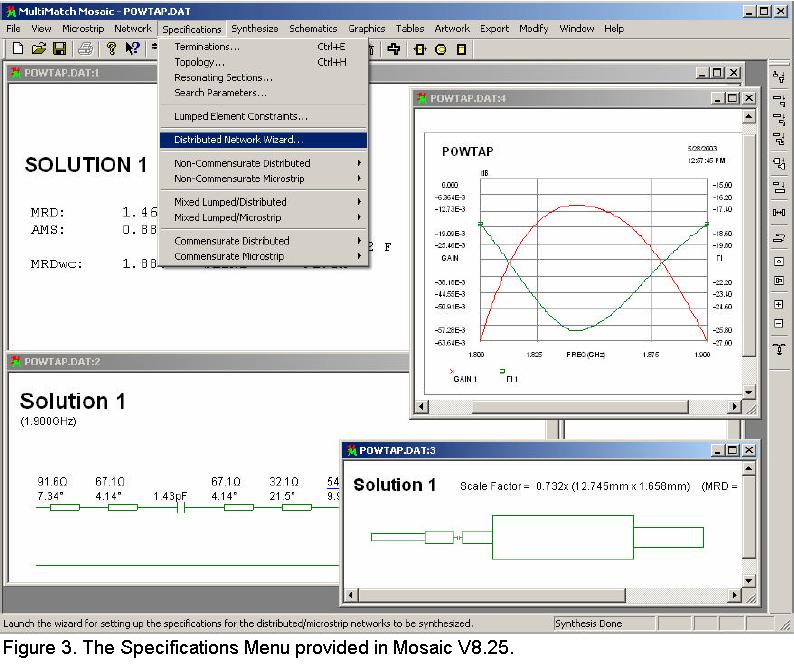
MultiMatch can be used to synthesize high dynamic range RF and microwave amplifiers, oscillators and impedancematching networks. Load-pull contours (1 dB compression point) can be generated for class A and class B amplifier stages with minimal data. Cascade and nodal power analysis and optimization capabilities are also provided.
Apart from an impedance-matching capability, device-modification (application of resistive feedback and/or resistive loading to a transistor) techniques are also required in order to design high performance first-time-right amplifiers. Sophisticated device-modification synthesis techniques are implemented in MultiMatch V7.70 and V8.40. Device-modification is used to pre-condition a transistor for improved stability, flat gain response, lower VSWRs (before synthesizing the matching networks required), as well as to have low VSWRs at the same time as a low noise figure and/or high output power.
Many first-time-right MultiMatch amplifiers have already been manufactured. MultiMatch V7.70 and V8.40 also has powerful oscillator synthesis capabilities. These include designing oscillators for maximum output power (class A, B). The loop gain and the (intrinsic) load line of the transistor are usually controlled in MultiMatch, but the option to control the negative resistance is provided too. The loop gain analysis capability can also be applied to amplifiers when feedback networks are used.
MultiMatch extends the power of the expert designer and also provides a learning curve for inexperienced circuit designers. In a professional setup, an accurate RF and microwave simulation program should be used to verify and improve the microstrip performance of the final MultiMatch circuit. External analysis and/or optimization will also be required when the intermodulation products and the harmonics must be minimized.
Platforms
MultiMatch and Mosaic are currently only supported on IBM compatible personal computers running under Windows 98?, Windows NTTM 4.0, Windows 2000TM or Windows XPTM (recommended).